

By Dominique Kegoum / Program assistant
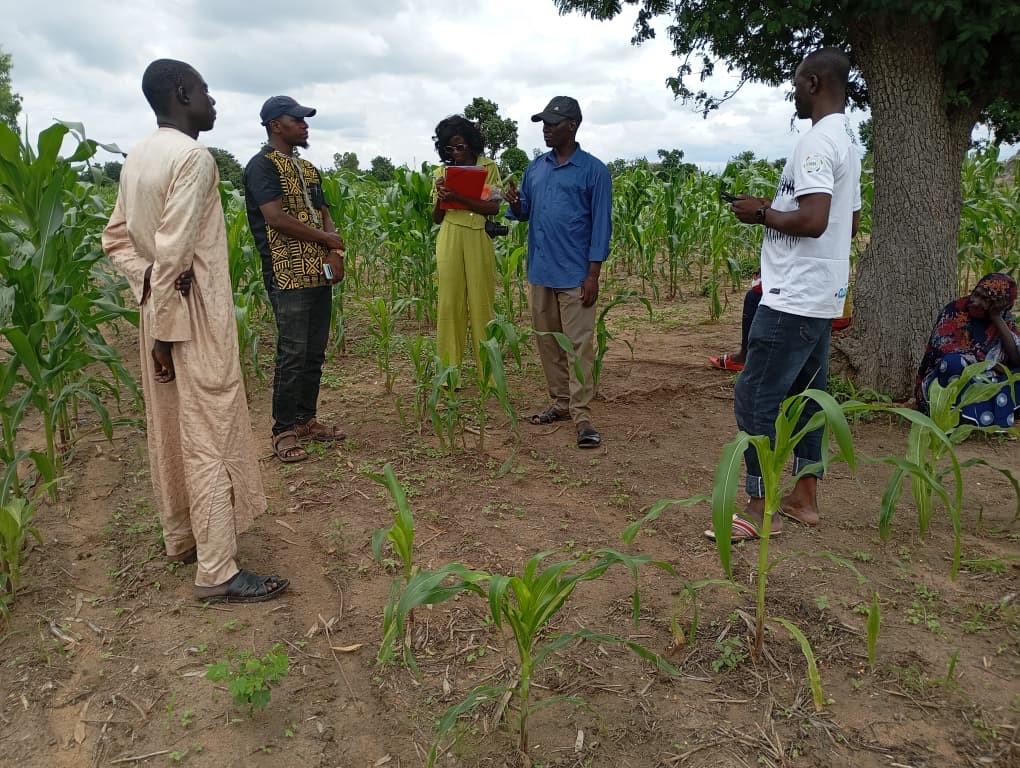
As part of the project “Strengthening the Engagement of Local Actors in Natural Resource Governance in Northern Cameroon” (REAL-GRNS), funded by the European Union and implemented by CED, FODER, and RELUFA, which aims to strengthen the involvement of local stakeholders in natural resource governance in the Adamawa and Northern regions of Cameroon through three components (land, mining, and food security), RELUFA, responsible for the food security component, conducted a study between December 2025 and January 2026 in the Northern and Adamawa regions. The study highlights a reality in which the resilience of food systems in Northern Cameroon depends directly on reducing gender inequalities. Far from being merely a social issue, gender emerges as a structural determinant of food security.
Women, the invisible pillar of food security in Northern Cameroon: The study reveals a major paradox in which women account for nearly 95% of food processing and marketing activities, yet remain marginalized in decision-making spheres. According to the study, 75% of decisions related to crop production in the Northern region and 68% in Adamawa are made by men. Only 15% (North) and 22% (Adamawa) of decisions are made jointly. Women mostly occupy subordinate positions within farmer organizations. Most strikingly, although 95% of women are involved in processing agricultural products, they control only about 12% of sales decisions.
Land inequality in Northern Cameroon: Access to land appears as the “original sin” of the food system. In the Northern region, patrilineal inheritance dominates (52%), systematically excluding women from land ownership. In Adamawa, access through purchase or gift is more common (42%) but remains fragile. The consequences of land inequality in the North are multiple: less than 8% of women have access to formal credit in the Northern region and less than 5% in Adamawa; women are often allocated the most degraded or remote lands; and the lack of land titles renders them “invisible” to financial institutions. As a result, climate resilience becomes impossible without land justice.
Climate, workload, and the feminization of vulnerability: Northern Cameroon is experiencing early droughts, delayed rains, and extreme heat waves. However, the study emphasizes that vulnerability is socially constructed. In rural households, men tend to migrate or diversify their economic activities, while women remain tied to the land and the household. These women simultaneously manage agricultural work, post-harvest processing, domestic responsibilities, and the long distances required to fetch water. The intersection of gender and education further deepens vulnerability: 42% of respondents in the Northern region have no formal education (compared to 28% in Adamawa), with illiteracy disproportionately affecting women.
Differentiated dynamics in the North and Adamawa regions: The study also highlights regional specificities. In the Northern region, agriculture is dominant (85%), social norms are rigid, and customary systems strongly restrict access to land. In Adamawa, there is greater diversification (agriculture, livestock, trade), better access to training (25% compared to 12% in the North), and slightly more visible female leadership (10% of women heading Common Initiative Groups). However, the glass ceiling persists in both regions.
©RELUFA
Positive masculinity: transforming power to strengthen resilience
The study highlights positive masculinity as a key lever for change. While a significant share of communities support power-sharing within households, 30% still associate such behaviour with male weakness. Social transformation is therefore underway but remains gradual and fragile. In this context, promoting “model couples” and positive masculinity clubs is recommended, as concerted household governance constitutes a powerful entry point for the long-term stabilization of food systems.
Vision 2030: Towards Female Rural Citizenship
Following this study, RELUFA’s strategic ambition is framed within a Vision 2030 built on three pillars: the institutionalization of gender in governance systems, the modernization of drudgery reduction (through mechanization and solar technologies to ease workloads), and adaptive resilience (including early warning systems managed by women).
The study concludes that food vulnerability in Northern Cameroon is less a climatic inevitability than a structural outcome of gender inequalities. Resilience will either be inclusive or it will not exist. Boreholes or seed distribution alone are not sufficient, as resilience is fundamentally about the distribution of power. Reducing gender inequalities is not a social luxury, but the most cost-effective lever for stabilizing local food systems.
For RELUFA, the challenge is clear: transforming power relations into drivers of sustainable development so that rural women are no longer invisible guardians of food security, but recognized, decision-making, and autonomous actors.

