

By Dominique Kegoum / Project assistant
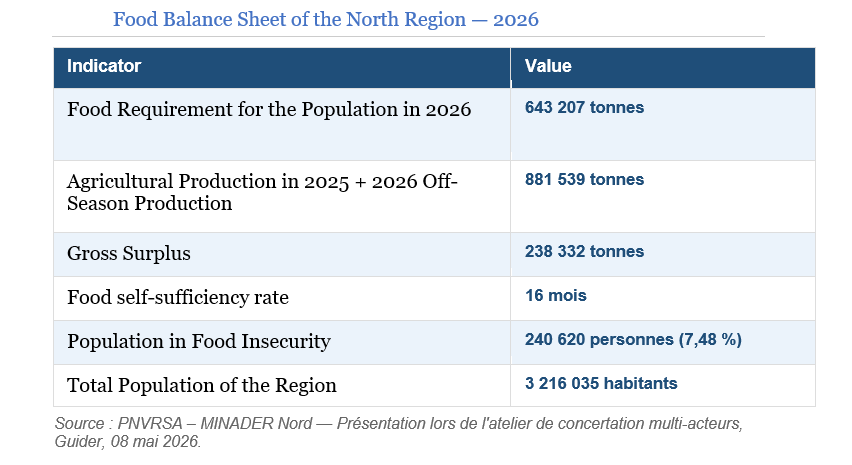
With a gross surplus of 238,332 tonnes of cereal products and a food coverage rate of 16 months, the North Region of Cameroon is experiencing a satisfactory food security situation in 2026. Nevertheless, 240,620 people, representing 7.48% of the population, remain food insecure. This article provides an overview of the data presented during the multi-stakeholder consultation workshop held on 8 May 2026 in Guider, organized by RELUFA (Network for the Fight Against Hunger) under the REAL-GRNS project (Strengthening the Engagement of Local Actors in the Governance of Natural Resources in Northern Cameroon), in collaboration with the North Regional Delegation of the Ministry of Agriculture and Rural Development (MINADER).
A productive 2024–2025 agricultural season
The 2024–2025 agricultural season recorded a production of nearly 1,049,427 tonnes in Cameroon’s North Region. This achievement was largely made possible through the PARPAC program, a national initiative that subsidizes seeds and agricultural inputs and has significantly boosted agricultural production across all regions of Cameroon.
In addition to this output, approximately 82,180 tonnes of cereals were produced during the 2026 off-season farming campaign. While this supplementary harvest alone is not sufficient to meet the region’s food requirements, it increases the total available regional cereal stock to 881,539 tonnes, well above the 643,207 tonnes required to meet the food needs of the population in 2026.
Accessible markets: a 40% decrease in food prices
Between January and May 2026, prices of staple goods fell by 40% compared to the same period the previous year. This decline is explained by the abundance of stocks available in local markets, a direct result of the good agricultural season in the previous year. In practical terms, households in the North now have continuous access to basic food. This stable supply, combined with low prices, temporarily places the region in a favourable situation regarding the four pillars of food security (availability, access, utilization, and stability).
According to the results of the Cadre Harmonisé (the reference analysis tool coordinated by MINADER with technical partners including FAO, WFP, UNICEF, and NGOs/civil society organizations), none of the departments in the Northern region is currently classified in the crisis phase (October 2025 session). In concrete terms, the Cadre Harmonisé classifies populations according to five phases of food insecurity, ranging from Phase 1 (minimal situation, no threat) to Phase 5 (famine). Phase 3, known as the “crisis phase,” refers to households facing significant food deficits or only able to meet their minimum food needs through severe coping strategies (such as selling livestock, reducing the number of meals, withdrawing children from school, etc.), which sustainably erode their livelihoods. Beyond this, Phases 4 (emergency) and 5 (famine) correspond to situations where people’s survival is directly threatened.
240,620 people, or 7.48% of the population, remain in a situation of food insecurity in the Northern region, despite a production surplus of 238,332 tons.
Some vulnerabilities that weaken households
Behind these generally positive indicators lie worrying field realities, highlighted during the Guider workshop. The decline in cereal prices (good news for consumers), in fact, proves disastrous for producers. By selling at lower prices, their purchasing power declines and their livelihoods deteriorate.
In addition to this phenomenon, there were several sudden but devastating shocks in early 2026. On March 30, floods affected 838 households in the Bibémi and Garoua I districts: 2,026 tons of crops, onions, sorghum, watermelon, okra, and cowpeas were lost across less than 685 hectares. In the Mayo-Rey Division, a fire destroyed 31 tons of cotton belonging to seven households. In addition, hippopotamus attacks along the Benue River deprived 25 families of 71 tons of off-season harvests over 17 hectares.
These shocks, often invisible in national statistics, illustrate the continued vulnerability of many farming households in the North in the face of climatic, environmental, and natural hazards.
What responses to strengthen population resilience?
Faced with these vulnerabilities, the National Vulnerability and Food Security Program (PNVRSA) for the North formulated several priority mitigation measures during the workshop. These include subsidizing agricultural inputs (seeds, fertilizers, insecticides) and farming equipment for producers, providing emergency food assistance to households in crisis, and distributing free inputs to internally displaced persons and victims of floods, fires, or wildlife attacks, as well as financial support to vulnerable households. These measures are part of a broader effort to strengthen the Food Security Working Group (GTSA) in the Northern region.
A collective dynamic to be sustained
The 2026 food security assessment in Northern Cameroon, therefore, reflects a region capable of abundant production, but where safety nets remain fragile. The holding of this consultation workshop in Guider (bringing together government administrations, civil society organizations, technical and financial partners, and local authorities) demonstrates a collective commitment to better coordinate interventions, share information, and anticipate crises. It is precisely this dynamic that RELUFA is committed to supporting and sustaining.

