

By Tina Amougou – Intern (RELUFA)
Food security in Cameroon has been under constant strain, particularly over the past decade. This is a complex problem fueled by persistent conflicts that have driven up the prices of food commodities in markets. According to the FEWS NET report on food security outlooks for the period from October 2025 to May 2026, the situation is alarming, especially in the North-West and South-West regions.
Conflict remains the main driver of food insecurity in Cameroon. Since 2013, jihadist groups such as Boko Haram and the Islamic State West Africa Province (ISWAP) have intensified their attacks in the Far North region of Cameroon. Likewise, clashes between the Cameroonian army and separatist groups in the North-West and South-West regions have displaced many people from their villages since 2017, turning them into internally displaced persons. These conflicts have not only disrupted agricultural activities but have also led to a significant decline in food production. In both cases, they have generated and continue to intensify strong pressure on the livelihoods of local communities. As a result, there has been a mass movement of largely farming populations who have abandoned their villages and plantations to seek refuge elsewhere.

According to the Famine Early Warning Systems Network (FEWS NET), cultivated land has decreased by 20 to 40 percent in conflict-affected areas of Cameroon, leading to a sharp rise in food prices across various markets. Thousands of households have lost their ability to produce food, leaving them unable to meet their food and nutritional needs and increasing their dependence on humanitarian assistance.
Between 1.5 and 1.99 million people, refugees, internally displaced persons, particularly those from the North-West and South-West, and vulnerable households, will require emergency food assistance between October 2025 and May 2026 (FEWS NET, 2026). Some of these vulnerable populations receive incomplete food baskets, while others are forced to cut their rations by half. In August 2025, the World Food Programme (WFP) was assisting about 115,000 people, representing less than 25% of the priority populations in certain areas. However, aid deliveries are often blocked or limited by insecurity, kidnappings, and restricted access for humanitarian organizations, making it critical to increase resources and improve response mechanisms ahead of the lean season.
Current dynamics suggest a possible worsening of the security crisis through May 2026: the persistence of violence in the North-West and South-West and the intensification of ISWAP attacks in the Far North are likely to continue constraining planting, harvesting, and agricultural employment. On February 7, 2026, a devastating fire ravaged a camp for internally displaced persons fleeing the Boko Haram insurgency in Kolofata, in the Mayo-Sava Division of the Far North Region of Cameroon. One person was killed, and 3,500 temporary shelters were destroyed, plunging thousands of already vulnerable families into humanitarian distress.
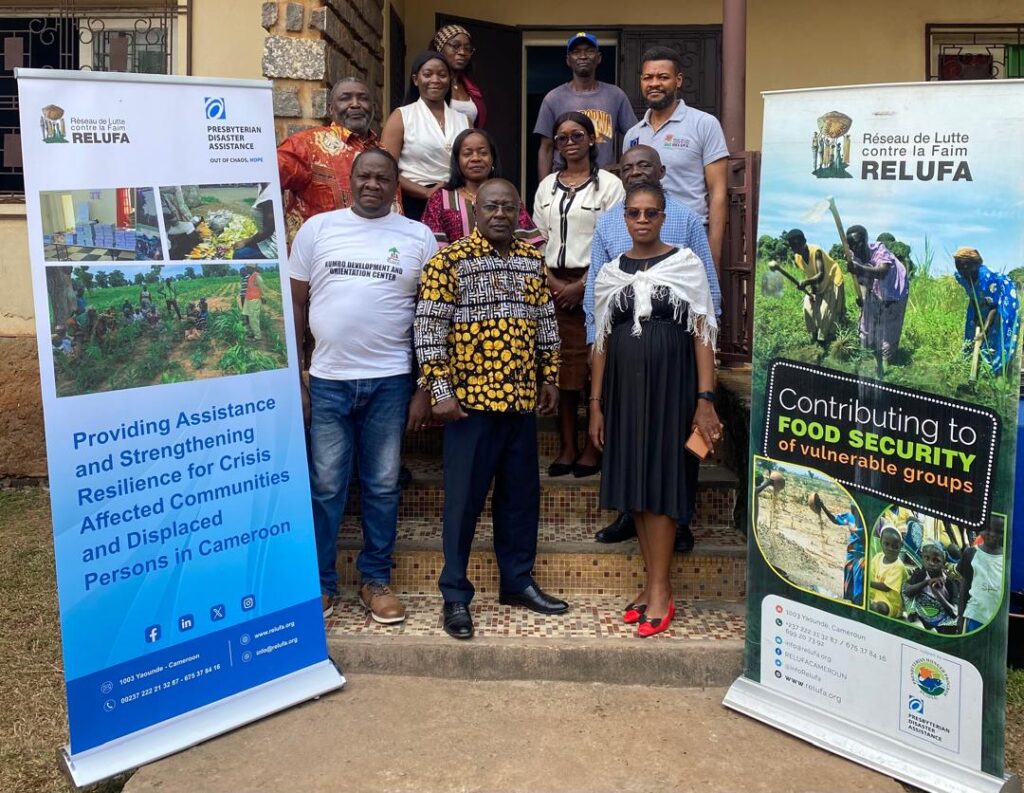
In this context, RELUFA launched a project in January 2026, with support from Presbyterian Disaster Assistance (PDA) of the Presbyterian Church in the United States This project aims to promote education for girls affected by the security crisis and to support vulnerable families in need with basic food items.
Cameroon is experiencing a prolonged food crisis, mainly driven by persistent conflicts and high food prices. Without a rapid and coordinated scale-up of food assistance, a significant deterioration is likely during the lean season (March–May 2026), with a risk of an increase in Emergency (IPC Phase 4) situations in the most isolated areas. Increased funding, improved humanitarian access, and targeted interventions are essential to limit the impact on vulnerable populations and prevent a major worsening of the food crisis.

